5.0 on Google Canyon Country (888) 960-6003
Air Conditioner Repair in Canyon Country

Canyon Country Local

5.0 from 1 Google reviews

Air Conditioner Repair in Canyon Country

David Medina personally handles every repair call serving Santa Clarita Valley homeowners.

Call or text (888) 960-6003

Request an estimate

Tell us what you need
No obligation


By submitting this form you agree that we may contact you about your request and share your name and email address with partner companies for email marketing. We never share your mobile number or text message consent with third parties or affiliates for marketing or promotional purposes.

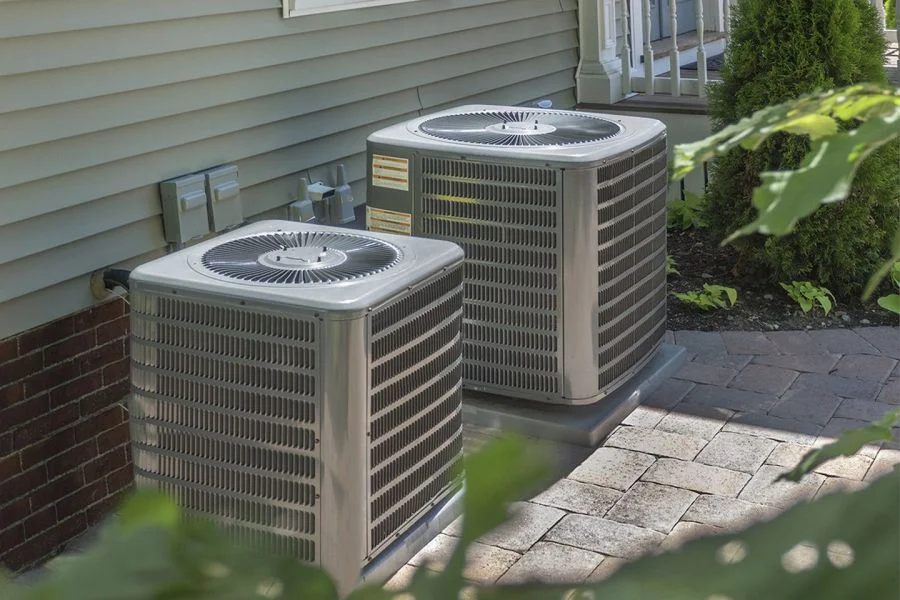
Two outdoor air conditioning units installed on a residential patio beside a house with siding.

Canyon Country AC Repair, Diagnosed Right

Air conditioner repair in Canyon Country is what Stay Cool Air Conditioning and Heating does, serving homeowners throughout the Santa Clarita Valley from our base right here in the 91387. When your system quits on a 108-degree July afternoon, you don't need a call center routing you to whoever's closest. You need David Medina, CA-licensed HVAC contractor #1036487, showing up with the right tools and a 25-year read on what breaks in this exact climate. Call (888) 960-6003 and you'll reach him directly.

Most AC failures in SCV homes trace back to a handful of causes: failed capacitors, low refrigerant from a slow leak, dirty condenser coils choking airflow, or a compressor drawing too many amps under heat stress. The diagnostic process matters as much as the repair itself. David checks refrigerant pressures against manufacturer specs, measures actual airflow, tests safety controls, and inspects the electrical components before quoting any part. That's what separates a repair that holds from one you're calling about again in three weeks. Cost depends on what failed, how hard the system has been running, and whether the refrigerant circuit is still intact. Every job is different. Contact Stay Cool Air Conditioning and Heating for an accurate estimate.

What AC Repair Covers Here

  • Full diagnostic: refrigerant pressures, airflow, electrical draw, safety controls
  • All major brands and system ages serviced
  • Capacitors, contactors, coils, refrigerant, motors and more
  • Same owner you spoke with is the one doing the work
  • CA HVAC license #1036487, work done to code, every time
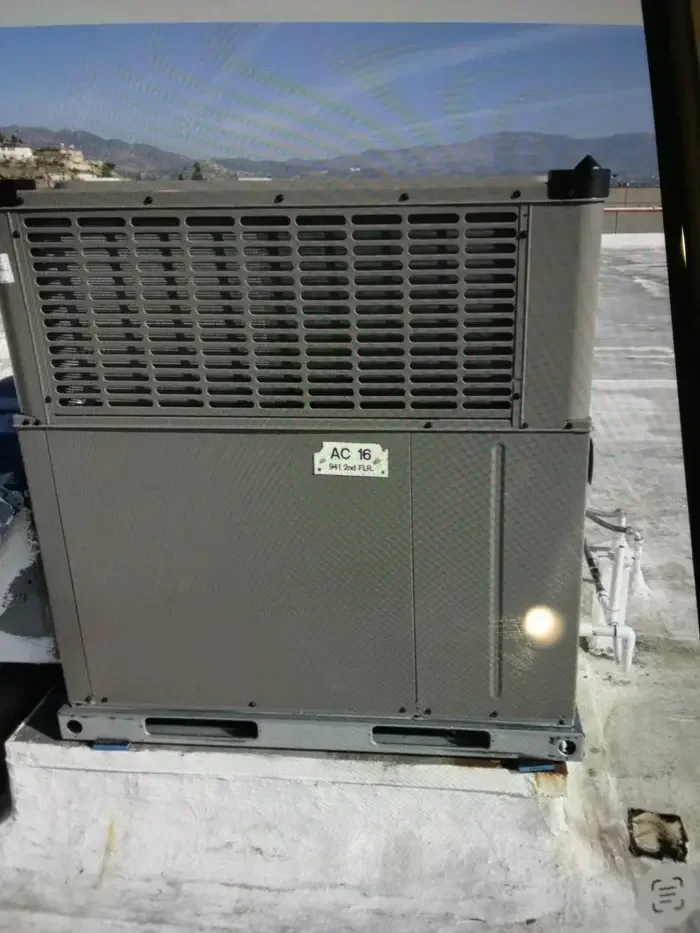
Rooftop-mounted air conditioning unit labeled AC 16 installed on a commercial building with mountain views in the background.

Common Failures

Why Your AC Stopped Cooling

These are the repairs that come up most in Canyon Country homes, especially after the first real heat wave of the year.

Failed Capacitor

Capacitors start and run the compressor and fan motors. Heat degrades them faster here than almost anywhere. A bad capacitor is usually a same-visit fix.

Refrigerant Leak

If the system is low on refrigerant, it can't transfer heat. The fix isn't a recharge; it's finding and sealing the leak first, then recharging to spec. Skipping the first step means calling again.

Dirty Condenser Coils

Canyon Country dust and cottonwood flock clog outdoor coils fast. When airflow is blocked, the system overheats and shuts down or loses cooling capacity well before it should.

Compressor Issues

The compressor is the most expensive single component in a central system. David checks amp draw and pressures before recommending compressor work, because a bad diagnosis here is an expensive mistake.

Thermostat Problems

Sometimes it's not the system at all. A miscalibrated or failing thermostat sends wrong signals and makes a perfectly good AC seem broken. Easy to rule out before anything else gets touched.

Restricted Airflow

Clogged filters, collapsed flex duct, or a blocked return starve the system of air. The coil freezes, the system shuts off, and nothing makes sense until you trace airflow back to the source. Poor duct condition is a frequent culprit.

The Diagnostic Process

What Happens on a Repair Visit
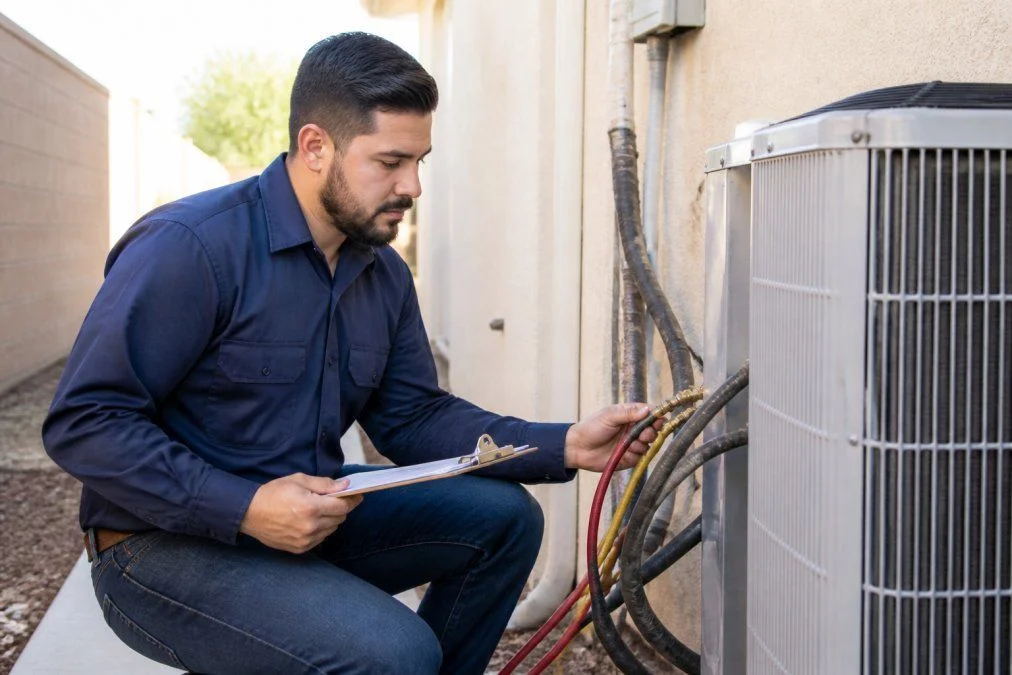
Every repair call starts the same way: a full look at the system before anything gets quoted or ordered. That means checking refrigerant pressures on both the high and low sides, measuring static pressure in the duct system, pulling amp readings on the compressor and fan motors, testing capacitors, and cycling through the safety controls. Canyon Country's heat pushes systems harder than the equipment was often sized to handle, so a component that tests marginal elsewhere fails outright here. Once David knows what actually failed versus what's just showing wear, he'll tell you plainly: this needs a repair, this can wait, and here's what it costs. No upsell pressure. If a repair makes sense, that's what gets quoted. If the system is old enough and worn enough that repair is throwing money at something that won't last another summer, he'll say that too. If you've been seeing climbing energy bills, an HVAC maintenance visit could catch the issue before it becomes a repair call. And if airflow feels uneven room to room, the problem may be upstream in the ductwork rather than the unit itself.
HVAC technician inspecting and documenting an air conditioning unit during a service call

Repair or Replace: How to Read It

Check the System's Age

Central AC systems last 15 to 20 years in moderate climates. In SCV, where systems run harder and longer, 12 to 15 years is realistic. Age alone isn't the answer, but it's the starting point.

Compare the Repair Cost

If the repair is minor relative to what a replacement costs, fix it. If you're looking at a compressor on a 14-year-old system, that math changes. David won't steer you toward replacement if repair is the right call.

Factor in Efficiency

An older, inefficient system running on borrowed time costs money every month in electricity, not just when it breaks. Sometimes replacement pays for itself faster than homeowners expect. See how to tell if your AC needs replacement for a straight breakdown.

What you get when you call Stay Cool

David Medina on every job
Owner-operated, not dispatched
CA HVAC License #1036487
C-20 certified, fully licensed
25+ years of field experience
In SCV homes, in this climate
5-star rated on Google
1 review, 5.0 average

AC Repair Questions, Answered

How do I know if my AC is low on refrigerant?
The clearest signs are warm air blowing from vents even though the system is running, ice forming on the refrigerant lines or evaporator coil, and a hissing or bubbling sound near the unit. A pressure check with manifold gauges confirms it in minutes. Low refrigerant always means a leak somewhere; a recharge without finding the source is a temporary fix.
What is the most common cause of low refrigerant?
Leaks at Schrader valves, service ports, or pinhole corrosion in the evaporator coil are the most common sources. Coil corrosion is especially common in areas where certain household chemicals off-gas near the air handler. Canyon Country homes that have had the same system 10 or more years are worth checking, since slow leaks can run for years before the system noticeably underperforms.
What should I do if my AC stops working during a heat wave?
First, check the thermostat setting and replace the filter if it's been a while. Check your breaker panel for a tripped breaker on the condenser circuit. If those are both fine and the system still won't cool, turn it off at the thermostat and call (888) 960-6003. Running a system that's struggling can damage the compressor, and compressor damage is expensive.
How often should an AC system be serviced in Canyon Country?
Once a year minimum, ideally in spring before the heat hits. SCV summers push systems to their limit for months, so going into that season with dirty coils, a weak capacitor, or low refrigerant means you're one hot afternoon away from a breakdown. An annual maintenance visit catches those things before they become emergency repairs.
Why is my AC running but not cooling effectively?
Four things account for most of these calls: low refrigerant, dirty condenser coils restricting heat rejection, a failing capacitor causing the compressor to underperform, or a duct problem losing cooled air before it reaches the living space. A proper diagnostic will identify which one it is rather than guessing and replacing parts. Canyon Country's dust load makes dirty coils the most frequent culprit in summer.
What is the 3-minute rule for AC?
It refers to waiting at least three minutes after shutting off an AC before restarting it. The compressor needs pressure to equalize between the high and low sides before it can start under normal load. Restarting too quickly puts the compressor under extreme stress and can cause it to fail or trip a breaker. If your system short-cycles or trips the breaker on startup, that's a symptom worth diagnosing.
Can my AC problems be related to the thermostat?
Yes, and it's one of the first things to rule out. A thermostat that's reading temperature incorrectly, losing its connection to the system, or simply set up wrong can make a functional AC appear broken. David checks thermostat operation on every repair call before moving to the mechanical components. If you want to upgrade to a voice-activated thermostat while he's there, that's an easy add.
What is the most common cause of low refrigerant in an AC system?
Leaks at Schrader valves, service ports, or pinhole corrosion in the evaporator coil are the most common sources. Coil corrosion is especially common in areas where certain household chemicals off-gas near the air handler. Canyon Country homes that have had the same system 10 or more years are worth checking, since slow leaks can run for years before the system noticeably underperforms.
How often does my air conditioner need maintenance in Canyon Country?
Once a year minimum, ideally in spring before the heat hits. SCV summers push systems to their limit for months, so going into that season with dirty coils, a weak capacitor, or low refrigerant means you're one hot afternoon away from a breakdown. A maintenance visit catches those things before they become emergency repairs.
What's the difference between a refrigerant leak and a compressor failure?
A refrigerant leak means the system is losing the fluid that moves heat. The compressor may still work fine, but without refrigerant it can't do its job, and eventually it will overheat. A compressor failure means the pump itself has failed mechanically or electrically. Manifold gauge readings and amp draw measurements tell you which one you're dealing with. They need different fixes, and confusing them is an expensive mistake.
How do I know if my AC system needs replacement versus repair?
Age and repair cost relative to replacement cost are the two honest factors. If the system is under 12 years old and the repair is a capacitor or contactor, fix it. If you're looking at a compressor on a 15-year-old unit, the numbers usually favor replacement. David will tell you which way it goes based on what he finds, not on which option costs more.

AC not cooling? Call now.

David Medina, owner and licensed HVAC contractor, takes the calls personally. CA license #1036487. Serving Canyon Country and the Santa Clarita Valley.

Related

Next step

Tell us about the job

Your name, your number and what needs doing. A person from Stay Cool Air Conditioning and Heating gets back to you.

Rather talk now?(888) 960-6003

★★★★★

The owner David came over and installed the air conditioning and furnace in record time, 4 hours. This was during a heat wave. He and his crew were professional and courteous. They are a great family run business 😊.
Denise S., Google review

No obligation


By submitting this form you agree that we may contact you about your request and share your name and email address with partner companies for email marketing. We never share your mobile number or text message consent with third parties or affiliates for marketing or promotional purposes.