
5.0 on Google Canyon Country (888) 960-6003
Heat Pump Installation in Canyon Country

Canyon Country Local

5.0 from 1 Google reviews

Heat Pump Installation in Canyon Country

Licensed C-20 contractor David Medina installs heat pump systems sized for Santa Clarita Valley homes.

Call or text (888) 960-6003

Request an estimate

Tell us what you need

No obligation


By submitting this form you agree that we may contact you about your request and share your name and email address with partner companies for email marketing. We never share your mobile number or text message consent with third parties or affiliates for marketing or promotional purposes.

Heat Pump Installation for Canyon Country Homes

Stay Cool Air Conditioning and Heating installs heat pump systems for homeowners throughout Canyon Country and the Santa Clarita Valley. David Medina holds California C-20 license #1036487 and has over 25 years of hands-on HVAC experience, so when you call (888) 960-6003, you're talking to the technician who'll actually show up. Heat pumps are one of the best fits for this climate: Canyon Country summers push past 100°F, but winters are mild enough that a properly sized heat pump handles both seasons efficiently without a separate furnace. If you're replacing an aging AC or looking to cut your energy bills, a heat pump installation is worth a real conversation.

What actually drives the cost of a heat pump installation isn't the brand on the box. It's the size of your home, the condition of your existing ductwork, whether your electrical panel needs an upgrade, and whether the system is ducted or ductless mini split. Older Canyon Country homes with undersized ducts may need duct work before the new system can perform correctly. Homes in newer developments off Whites Canyon or Sierra Highway generally have ductwork that's already compatible. Every situation is different. Contact Stay Cool Air Conditioning and Heating for an accurate estimate.

What Heat Pump Installation in Canyon Country Covers

  • Full system installation: outdoor condenser unit, indoor air handler, refrigerant line set, electrical connections
  • Existing ductwork inspection and compatibility check before any equipment is ordered
  • Proper system sizing based on your home's square footage and insulation, not a rough guess
  • Permit-compliant installation per Santa Clarita Valley building codes
  • Post-installation startup test and thermostat calibration before we leave

Why Heat Pumps

Heat Pumps Actually Make Sense Here

Canyon Country's climate is one of the better arguments for a heat pump in Southern California.

One System, Two Seasons

A heat pump handles cooling in summer and heating in winter from the same unit. You don't need a separate furnace for Canyon Country winters, which rarely drop low enough to push a heat pump out of its efficient range.

Lower Operating Costs

Heat pumps move heat rather than generate it, which makes them more efficient than a straight electric furnace. Over a full year of SCV weather, most homeowners see that show up on their utility bills.

Federal Tax Credits Still Apply

California's TECH Clean California program has also offered rebates for homeowners switching from gas. Ask David about which credits apply to your situation.

Ducted or Ductless

If your home has existing ductwork in reasonable shape, a ducted split heat pump is usually the right call. Garages, additions, and ADUs without ducts are strong candidates for a ductless mini split heat pump instead.

Long Service Life

A well-installed heat pump in a mild climate like Canyon Country typically lasts 15 to 20 years with regular HVAC maintenance. That's a longer return on the investment than most people expect.

How It Works

What to Expect During Installation

  1. Site Assessment

    David looks at your existing equipment, ductwork condition, electrical panel capacity, and home layout before recommending a system. No equipment is ordered before that step.

  2. Permit and Installation

    We pull the required permits, install the outdoor unit on a level pad, mount the air handler, run refrigerant lines, make electrical connections, and confirm everything meets code.

  3. Startup and Handoff

    After installation, we run a full system test, verify refrigerant charge, calibrate the thermostat, and walk you through operation before we leave. No guesswork left behind.

Heat Pump vs. AC vs. Furnace: Which One Fits Your Home
A lot of Canyon Country homeowners come into this conversation thinking they need to replace a broken AC with another AC. That's not always the right answer. If your home currently runs on a gas furnace and a separate central AC, a heat pump can replace both in one installation. That means one piece of equipment to maintain, one system to service, and one contractor to call. The tradeoff is upfront cost: a heat pump installation typically costs more than a straight AC replacement. But with federal tax credits and lower operating costs over time, the math often works in the heat pump's favor for homeowners planning to stay in the house another 10-plus years. If your home is older and relies heavily on gas heat, or if your ductwork is in poor shape, a furnace replacement paired with a new AC might still be the more practical near-term solution. That's not a conversation I'll dodge. I'd rather tell you what actually fits your home than sell you something that doesn't.
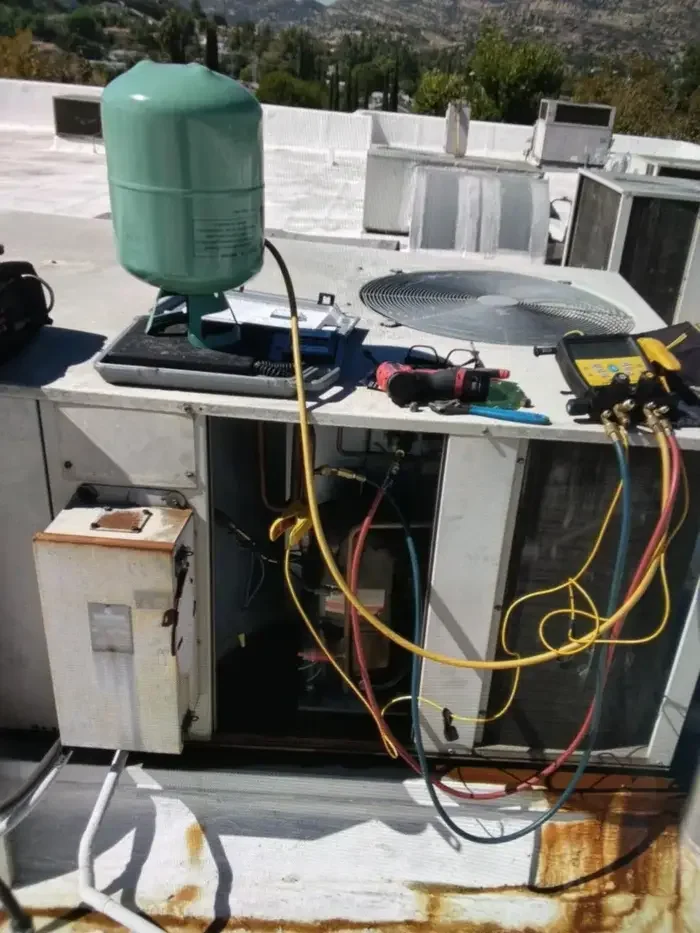
HVAC system installation and service work on a rooftop, showing pressure tank, condensing unit, electrical connections, and associated equipment.

What You Get With Stay Cool

Stay Cool is a local, family-owned business. David Medina is the owner, the licensed contractor, and in most cases, the technician on your job.

CA C-20 Licensed
License #1036487, verifiable on the CSLB website
Owner on the job
David Medina handles installs personally, not subcontracted labor
Permit-compliant work
Every installation meets Santa Clarita Valley building code requirements
5-star Google rating
Verified on Google, 5 stars across all reviews

Frequently Asked Questions

How much does heat pump installation cost in Canyon Country?
Cost depends on system size, ductwork condition, electrical panel capacity, and whether you're going ducted or ductless. A home that needs panel upgrades or new ductwork will cost more than one that's already set up for a straight swap. Every job is different. Contact Stay Cool Air Conditioning and Heating for an accurate estimate.
Is there a federal tax credit for heat pump installation in 2024 or 2025?
Yes. California's TECH Clean California program has also provided rebates for homes transitioning away from gas heating. Eligibility depends on equipment specifications and your household's tax situation, so confirm the details with your tax professional before counting on a specific amount.
What is the difference between a heat pump and a traditional air conditioner?
An air conditioner only moves heat in one direction: out of your home during summer. A heat pump runs the same refrigeration cycle in reverse during winter, pulling heat from outdoor air and moving it inside. In Canyon Country's mild winters, there's enough heat in outdoor air for this to work efficiently down to temperatures we rarely see here. The result is a single system that handles both seasons.
How long does a heat pump last in Southern California?
In Canyon Country's climate, a properly installed heat pump commonly runs 15 to 20 years before needing replacement. The inland valley heat means the cooling side works hard in summer, so annual air conditioner maintenance and refrigerant checks extend that lifespan meaningfully. Systems that skip maintenance typically show wear well before the 15-year mark.
Can a heat pump work efficiently in Canyon Country's summer heat?
Yes, with the right system sizing. Canyon Country regularly hits 100°F-plus in summer, and a heat pump's cooling performance is rated by SEER2, the same metric used for central AC. The key is proper load calculation before installation: an undersized unit will run constantly and never catch up. David sizes every system to the actual home, not a rule-of-thumb guess.
Do I need to upgrade my electrical panel for a heat pump?
It depends on your home's current electrical capacity. Many Canyon Country homes built in the 1980s and 1990s have 100-amp or 150-amp panels. All-electric heat pump systems often require a dedicated 240V circuit and sometimes a panel upgrade to 200 amps if the existing service is at capacity. David checks panel capacity during the site assessment so there are no surprises on installation day.
What is the difference between a ducted and ductless heat pump?
A ducted heat pump connects to your home's existing air distribution system and conditions the whole house through vents, the same way a central AC does. A ductless system (also called a mini split) installs wall-mounted indoor heads and works without ductwork, making it the right choice for garages, room additions, and ADUs. If your existing ducts are in poor condition, we'd look at whether duct repair or a ductless system is the better path before recommending equipment.
Is there a federal or California tax credit for installing a heat pump in 2024-2025?
California's TECH Clean California program has also offered rebates for homes switching away from gas heat. Eligibility depends on equipment specs and your tax situation, so confirm with a tax professional before counting on a specific dollar amount.
What is the difference between a heat pump and traditional air conditioning?
A standard air conditioner only removes heat from your home in summer. A heat pump runs the same refrigerant cycle in reverse during winter, extracting heat from outdoor air and moving it inside. That means one system handles both cooling and heating, which is a practical advantage in Canyon Country where winters are real but rarely severe.
How long does a heat pump typically last?
In a climate like Canyon Country's, a well-installed heat pump commonly lasts 15 to 20 years. The cooling side works hard during SCV summers, so annual maintenance and refrigerant checks extend system life. Units that skip maintenance tend to show compressor wear before the 15-year mark.
Can a heat pump handle Canyon Country's summer heat efficiently?
Yes, provided it's correctly sized for your home. Canyon Country regularly exceeds 100°F, and a heat pump's cooling output is rated just like a central AC's. The difference between a system that keeps up and one that runs constantly all summer is proper load calculation before the equipment is ordered, which is part of Stay Cool's site assessment.
Will I need an electrical panel upgrade for a heat pump?
Many older Canyon Country homes run 100-amp or 150-amp panels, and an all-electric heat pump system often requires a dedicated 240V circuit. If your existing panel is at capacity, an upgrade may be necessary before installation. David checks this during the site visit so there are no last-minute surprises.
What is the difference between a ducted and ductless heat pump system?
A ducted heat pump connects to your existing ductwork and conditions the whole house through your current vents. A ductless mini split installs wall-mounted heads and skips ductwork entirely, which makes it the right fit for garages, additions, and ADUs. If your ducts are in rough shape, we look at duct repair versus going ductless before recommending any equipment.

Ready to Talk Heat Pumps?

One call, one contractor, no runaround.

Related

Next step

Tell us about the job

Your name, your number and what needs doing. A person from Stay Cool Air Conditioning and Heating gets back to you.

Rather talk now?(888) 960-6003

★★★★★

The owner David came over and installed the air conditioning and furnace in record time, 4 hours. This was during a heat wave. He and his crew were professional and courteous. They are a great family run business 😊.
Denise S., Google review

No obligation


By submitting this form you agree that we may contact you about your request and share your name and email address with partner companies for email marketing. We never share your mobile number or text message consent with third parties or affiliates for marketing or promotional purposes.